

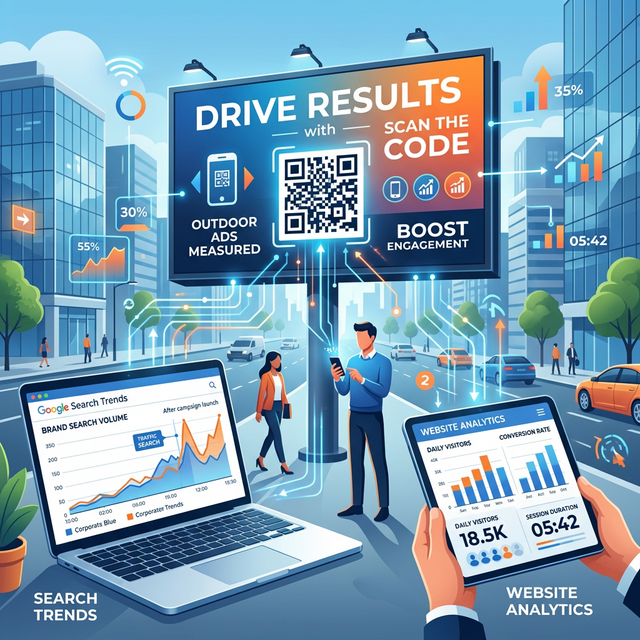
Measuring the Success of Your Billboard Campaign: Beyond Just Impressions
For a long time, outdoor advertising (OOH) was often viewed as a "branding only" medium where success was measured mostly by estimated impressions and reach. However, in today's data-driven world, advertisers need more tangible proof of ROI.
Integrating digital tracking methods with your physical billboard campaign allows you to close the loop between offline exposure and online action.
1. Using QR Codes on Billboards
QR codes have seen a massive resurgence and are now one of the most effective ways to bridge the gap between a physical billboard and a digital conversion.
Best Practices for QR Codes:
- Size Matters: Ensure the QR code is large enough to be scanned from a distance.
- UTM Parameters: Always use a unique URL with UTM parameters (e.g.,
?utm_source=billboard&utm_campaign=summer_sale) so you can isolate this traffic in your analytics. - Call to Action: Give people a reason to scan. "Scan for 10% off" works much better than just a lonely code.
- Landing Page Optimization: Make sure the page they land on is mobile-optimized and directly relevant to the billboard's message.
2. Analyzing Google Search Trends
A successful billboard campaign often leads to an increase in "brand searches"—where people who saw your ad later search for your company name or specific offering.
By using Google Trends or your own Google Search Console data, you can look for spikes in search volume that correlate with your campaign dates and locations.
- Geographic Spikes: If your billboard is in Mumbai, look for a disproportionate increase in searches coming from the Mumbai region compared to other cities.
- Keyword Correlation: If your billboard highlights a specific new product or a unique slogan, monitor searches for those exact terms.
3. Company Website Analytics
Your website analytics (like Google Analytics 4) provides a wealth of information about how offline ads impact online behavior.
- Direct Traffic Spikes: Many people will simply type your URL into their browser after seeing a billboard. Monitor your "Direct" traffic source for significant upticks during the campaign period.
- Landing Page Performance: If you used a specific, easy-to-remember URL (e.g.,
yourbrand.com/save) on the billboard, you can track visits to that specific page as a direct result of the campaign. - Conversion Rate: Analyze if the traffic coming from specific billboard-driven sources (like the QR code) converts better or worse than your average visitor.
4. Promo Codes and Vanity URLs
While not purely digital, these two methods are classic for a reason:
- Promo Codes: Use a unique code like "BILLBOARD20" to track exactly how many sales came directly from the outdoor ad.
- Vanity URLs: Use a short, memorable custom URL that only appears on the billboard (e.g.,
brand.link/city).
Conclusion
Measuring a billboard campaign doesn't have to be a guessing game. By combining physical ads with digital tracking tools, you can get a much clearer picture of your campaign's true impact and optimize your future advertising spend for maximum ROI.
Ready to start a measurable campaign? Browse available billboards or contact our team for expert advice on tracking your next outdoor ad.
Harnessing the power of data makes billboard advertising more effective than ever. How are you measuring your campaigns?