

Digital vs Traditional Billboards: Which Should You Choose in 2025?
My friend Suresh makes ₹20 lakhs monthly from a single digital billboard in Pune. He paid ₹65 lakhs to install that LED screen three years ago, and it's been profitable from month one because he sells time slots to twelve different advertisers. His neighbor, meanwhile, owns three traditional billboards that cost ₹8 lakhs total to set up and generate ₹1.8 lakhs monthly. Both are happy with their choices. Both made the right decision for their specific situations.
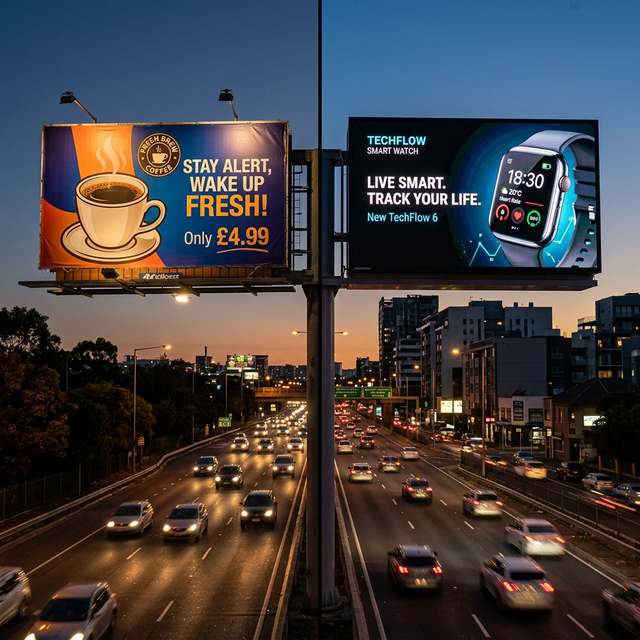
The digital versus traditional billboard debate isn't about which is objectively better. It's about which is better for your specific goals, budget, location, and business model. This guide will help you make that decision based on real-world economics, not marketing hype.
Understanding Traditional Billboards First
Let's start with what most people picture when they hear "billboard." Traditional billboards are physical printed advertisements mounted on structures. The image is static—once it's up, it stays up until you physically replace it.
The basic economics are straightforward. You rent the location (₹25,000 to ₹3 lakhs monthly depending on placement), print your creative (₹15,000-₹30,000 one-time), install it (₹5,000-₹10,000), and you're done. Your message stays visible 24/7 for the duration of your contract. Simple, predictable, proven.
The real strength of traditional billboards is sustained presence. Your ad doesn't rotate or compete for attention with others. It's always there, building familiarity with everyone who passes regularly. A commuter sees your billboard twice daily, every working day. After a month, they've seen it 40-50 times. That repetition builds powerful brand recall.
Traditional billboards excel for consistent, long-term brand building. They're perfect for businesses wanting to establish market presence, for messages that don't change frequently, and for advertisers who value predictable costs over flexibility. A local restaurant, coaching center, or real estate project benefits more from constant visibility than flashy animations.
The limitations are equally clear. Once your creative is printed and installed, changing it requires reprinting (₹15,000-₹30,000) and reinstallation (₹5,000-₹10,000). If your message becomes outdated, if you have a new promotion, or if you simply want to test different creative, you're looking at significant costs and multi-day downtime.
Weather is your enemy. Heavy rain, strong winds, harsh sun—all degrade your billboard over time. Colors fade, vinyl tears, edges peel. Most traditional billboards need replacement after 6-12 months even if the advertiser hasn't changed, simply due to wear. This isn't a dealbreaker, but it's a hidden cost many first-timers underestimate.
Digital Billboards: The New Reality
Digital billboards—LED screens displaying rotating advertisements—have transformed outdoor advertising in urban India. Instead of one advertiser owning the board, multiple advertisers buy time slots. Your 10-second ad plays, then another advertiser's, then another, cycling throughout the day.
The economics work completely differently. Instead of exclusive board rental, you pay per time slot. A typical arrangement might be 100-200 plays per day (10 seconds each), rotating with 5-8 other advertisers. In a prime location, this might cost ₹8,000-₹15,000 per 10-second slot per month, working out to ₹80,000-₹3 lakhs monthly depending on location and frequency.
The massive advantage is flexibility. Your creative is digital—you can change it instantly without printing or installation costs. Running a weekend sale? Update your ad Friday morning. Weather turns cold? Promote hot products. Festival coming? Create festival-themed creative. All of this happens within hours at zero cost beyond the initial design work.
Multiple messages become possible. You could rotate three different creatives for the same cost—one highlighting your product, one your service, one a current promotion. Traditional billboards force you to choose one message for months. Digital billboards let you test and iterate constantly.
The downside is shared attention. Your ad appears for 10 seconds, then disappears for maybe 60-90 seconds while other ads play. Viewers need to be looking at exactly the right moment. If they glance away or get distracted, they miss your ad entirely. Traditional billboards don't have this problem—they're always visible.
Cost per impression is often higher on digital. Yes, digital boards get lots of eyeballs, but you're paying for only 10 seconds at a time. A traditional billboard gets eyes-on 24/7. Run the math: a digital slot getting 200 plays daily is visible for 2,000 seconds daily (about 33 minutes). A traditional billboard is visible for 86,400 seconds daily (1,440 minutes). You're paying similar money for dramatically less total visibility time.
The Real Cost Comparison
Let me break down actual total costs because this is where confusion happens. Everyone focuses on monthly rental costs and misses the complete picture.
For traditional billboard campaigns, calculate everything. Location rental might be ₹60,000 monthly. Design costs ₹10,000 one-time. Printing costs ₹20,000 one-time. Installation costs ₹8,000. For a 6-month campaign, your total is ₹3,60,000 rental + ₹38,000 production = ₹3,98,000 total, or ₹66,333 monthly average when you spread production costs.
But here's what people forget: replacement. If your campaign runs 12 months in harsh weather, you might need to reprint and reinstall at month 6. Add another ₹28,000. So that ₹60,000 monthly rental really costs ₹65,333 monthly when you factor in production and maintenance over a year.
For digital billboard campaigns, the costs seem simpler but can be deceptive. You're paying ₹1,20,000 monthly for time slots. Creative design costs ₹12,000 (one-time for basic animation). That seems cheaper—no printing, no installation, no weather damage. And it is cheaper... if you don't change your creative.
But the whole point of digital is flexibility, right? If you actually use that flexibility and update creative quarterly, you're paying ₹12,000 every three months for new designs. Over a year, that's ₹48,000 in design costs versus ₹10,000-₹20,000 for traditional. Your ₹1,20,000 monthly cost is actually more like ₹1,24,000 monthly when averaged annually.
Now factor in effectiveness. Your digital ad shows 200 times daily for 10 seconds. Your traditional billboard shows continuously for 24 hours. Which generates more actual brand recall? Research suggests repeated, sustained exposure (traditional) often outperforms brief, rotating exposure (digital) for long-term brand building, though digital wins for urgent, time-sensitive promotions.
When Traditional Billboards Make More Sense
Let me give you specific scenarios where traditional billboards are the better choice, based on real campaigns I've analyzed.
If you're building long-term brand presence in a local market, traditional wins. A neighborhood restaurant wants people driving past daily to become familiar with their brand. Repetitive, consistent visibility over 6-12 months builds that recognition far better than 10-second digital rotations. Every successful local business I know that uses billboards uses traditional for exactly this reason.
When your message is evergreen and doesn't need updating, paying for digital's flexibility is wasteful. A clinic advertising dental implants, a real estate project announcing new launches, a coaching center listing their success rate—these messages stay relevant for months. You don't need to change them weekly. Traditional billboard costs less and performs better for these sustained campaigns.
Budget-conscious advertisers benefit from traditional billboards. Entry-level traditional billboard campaigns start at ₹20,000-₹30,000 monthly all-in including production. Equivalent reach on digital billboards costs 2-3 times more. For small businesses, startups, or anyone watching every rupee, traditional delivers more value per rupee spent.
Tier-2 and tier-3 cities often lack quality digital billboard infrastructure. In smaller cities, your choice might be traditional billboards or nothing. Even where digital exists, traditional billboards are so much cheaper that it's not even a fair comparison. The same money that gets you one digital slot might get you three traditional billboards in a tier-2 city.
Markets with older demographics or lower-income audiences respond better to traditional billboards. Digital's flash and movement appeals to younger, urban audiences. But if you're targeting small business owners, senior citizens, or rural/semi-rural audiences, traditional billboards' sustained presence is more effective. They're used to static signage and process it better.
When Digital Billboards Are Worth It
Now let's flip the discussion. When does paying 2-3 times more for digital make business sense?
If you have frequently changing promotions, digital is invaluable. Fashion retail with weekly sales, QSR chains with combo deals changing every month, e-commerce platforms with festival offers—these businesses waste money on traditional billboards. By the time you print and install a new creative announcing a sale, the sale is half over. Digital lets you promote today's offer today, this week's product this week.
Brand launches and time-sensitive campaigns benefit enormously from digital. You're launching a new product with a 2-month intensive campaign. You want three different messages highlighting different features. Traditional means three different billboards at 3x cost. Digital lets you rotate all three messages on the same screen for one price.
High-traffic premium locations make digital economics work better. A digital billboard at a major Mumbai intersection reaches maybe 2 lakh people daily. Multiple advertisers splitting that reach means you're tapping into location value you could never afford exclusively. Digital democratizes access to premium locations through the time-sharing model.
Testing creative and messages is dramatically cheaper with digital. Want to test which headline works better? Run version A for two weeks, version B for two weeks, track response, then go with the winner. Traditional billboards make testing prohibitively expensive. Digital makes it standard operating procedure.
Corporate image and modern brand positioning sometimes demand digital. If you're a fintech company, a tech startup, or a modern retail brand, a traditional static billboard might feel outdated. Digital billboards signal innovation and modernity. Sometimes that perception value justifies the extra cost, even if traditional might drive similar sales.
The Hybrid Approach Few Consider
Here's a strategy that's criminally underused: use both. Not either-or, but strategic combination.
Deploy traditional billboards for core brand messaging in your primary market. These stay up year-round, build sustained recognition, and cost less. Then supplement with digital billboards for tactical campaigns, promotions, and seasonal pushes. A café might have two traditional billboards near residential areas year-round, then add digital billboard slots for festival seasons promoting special menus.
Geographic layering works brilliantly. Use traditional billboards in tier-2 cities and suburbs where costs are low and audiences prefer sustained presence. Use digital billboards in tier-1 metro cores where competition is intense and audiences expect dynamic content. A national brand might have 50 traditional billboards across 20 smaller cities and 10 digital slots in top metros. Total reach is maximized while controlling costs.
Message hierarchy helps prioritize spending. Your core brand message ("India's Most Trusted Dental Chain") goes on traditional billboards for year-round presence. Your promotional messages ("Teeth Whitening 50% Off This Month") go on digital billboards for 2-4 week bursts. This separation ensures sustained brand building while allowing tactical flexibility.
Budget staging allows entry at any level. Start with one traditional billboard to prove the concept and generate ROI. Use that cash flow to add a second traditional billboard. Once you have 3-4 traditional billboards generating consistent revenue, add digital slots for promotional campaigns. This staged approach requires minimal upfront capital while building toward a sophisticated multi-format campaign.
Making Your Decision: A Practical Framework
Stop thinking "which is better" and start asking "which is better for my specific situation." Here's how to actually decide.
First, define your objective clearly. Is it brand awareness (traditional wins), promotional response (digital wins), or long-term market presence (traditional wins)? Be honest—most advertisers say they want "brand awareness" but actually want immediate sales. Digital is better for immediate response, traditional for sustained presence.
Second, analyze your message stability. Will your core message stay consistent for 6+ months? Traditional. Will you need to update content monthly or more frequently? Digital. Don't lie to yourself here. Many businesses think they'll change content constantly, then discover they're happy with the same message for 8-9 months.
Third, calculate true comparative costs. Take the traditional billboard option—factor in production, installation, replacement over 12 months. Take the digital option—factor in design costs for however many creative updates you'll realistically do. Which delivers better value? Often traditional, but not always.
Fourth, consider your target audience. Younger urban audiences (18-35) respond well to digital's dynamic nature. Older audiences (40+) or more traditional demographics often respond better to static billboards they can read completely without time pressure.
Fifth, evaluate location availability and quality. Sometimes you don't have a choice—only digital exists in your target location, or only traditional. Make the decision based on what's actually available, not theoretical preferences.
Finally, assess operational capacity. Digital billboards demand more management—updating creative, monitoring performance, coordinating changes. Traditional billboards need minimal ongoing attention. If you're a time-starved entrepreneur or small business, traditional's simplicity might be worth more than digital's flexibility.
Real-World Decision Examples
Let me show you how three different businesses made this choice and what happened.
A coaching center in Indore wanted to advertise near three colleges. They had budget for either one digital billboard slot or three traditional billboards. They chose three traditional billboards because their message ("JEE Coaching - 95% Selection Rate") stayed constant, and they wanted sustained presence at all three college locations. Result: 40% increase in enrollments over 12 months. Digital wouldn't have allowed them to surround their target audience the same way.
A fashion retail chain in Bangalore runs monthly sales and product launches. They tried traditional billboards for six months, spending ₹8 lakhs and constantly frustrated by inability to update messaging. They switched to digital billboard slots costing ₹12 lakhs annually, but now they update creative 15-20 times per year highlighting different sales, collections, and promotions. Their store foot traffic increased 60% and they credit digital's flexibility.
A real estate developer in Ahmedabad promoting a luxury project used both strategically. They installed five traditional billboards along the highway from the airport showing their project name and tagline. This built sustained awareness over 18 months. Then they booked digital billboard slots in premium locations for 45-day intensive campaigns during festival seasons when buyers are actively looking. Traditional built brand, digital drove conversions during high-intent periods.
The Technology Evolution Factor
Here's something most people don't consider: billboard technology is evolving fast. Your decision today might look different in 2-3 years.
Digital billboards are getting cheaper. Three years ago, a quality LED billboard cost ₹80-₹1.2 crores to install. Today, you can find decent screens for ₹40-₹70 lakhs. As Chinese manufacturers scale production and Indian assembly increases, costs will keep dropping. Digital might become financially competitive with traditional sooner than people think.
Traditional billboards are getting better too. Weather-resistant materials, longer-lasting inks, better structural engineering—these improvements mean traditional billboards maintain quality longer, reducing replacement costs. A billboard that needed replacement after 8 months in 2020 might last 14 months in 2025.
Programmatic digital advertising is coming to Indian billboards. Imagine buying digital billboard time like you buy Google ads—instant booking, real-time price optimization, audience targeting, performance tracking. This technology exists globally and will reach India's major metros soon. When it does, digital billboard buying will become far more accessible to small businesses.
Augmented reality and interactive billboards are the next frontier. Scan a QR code on a billboard and watch a 3D product demonstration on your phone. Traditional static billboards can't do this, and even current digital billboards are limited. The outdoor advertising of 2028 will look very different from 2025, which looked very different from 2022.
The Honest Bottom Line
After years of analyzing billboard campaigns, here's my unbiased take: for most small and medium businesses in India in 2025, traditional billboards deliver better ROI. They cost less, they build sustained presence, and they're operationally simpler. Digital billboards are powerful for specific use cases but aren't inherently better for typical advertisers.
That said, large brands, businesses with frequently changing promotions, and advertisers in tier-1 metros should seriously consider digital or hybrid approaches. The flexibility and modern appeal justify the cost premium for these segments.
Don't let anyone tell you one is universally better. Make your decision based on your budget, objectives, message stability, target audience, and operational capacity. Both traditional and digital billboards work. Both generate ROI when used appropriately. The worst decision is not choosing wrong—it's choosing without clear reasoning.
And remember: you can always start with one approach and add or switch to the other. Billboard advertising isn't a life sentence. It's a flexible marketing channel that should evolve as your business grows and your needs change. Start where you're comfortable, measure results, and adjust from there.