

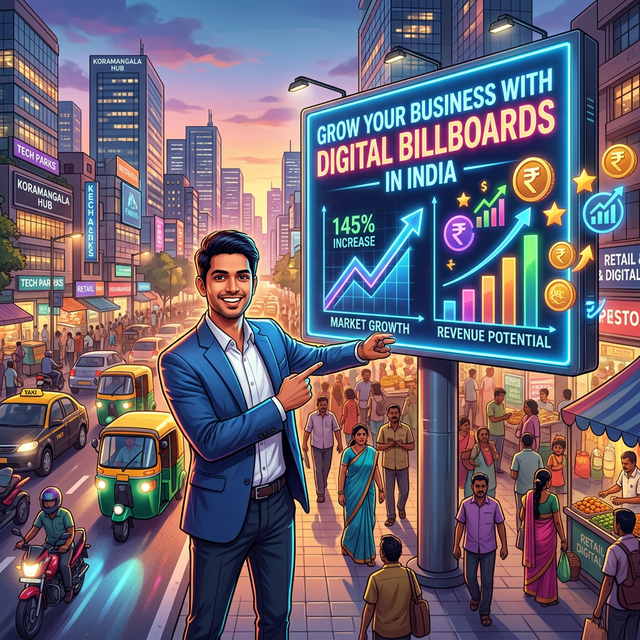
The Billboard Business Opportunity Nobody's Talking About in India (2026 Guide)
Last month, I met a 32-year-old entrepreneur in Pune who runs a business most people have never heard of. He doesn't have an office, barely has any employees, and yet his business generates over ₹1.2 crores annually. His secret? He broker billboard advertising deals.
This isn't an isolated story. Across India, a quiet revolution is happening in outdoor advertising. While everyone obsesses over the next food delivery app or ed-tech platform, smart entrepreneurs are building sustainable, profitable businesses in the unglamorous world of billboards. And the best part? The barrier to entry is surprisingly low.
Let me take you inside this world and show you opportunities you probably didn't know existed.
Why Billboard Advertising is Booming Right Now
Something interesting has happened in Indian advertising over the past few years. Digital advertising got saturated and expensive. Brands spent millions on Instagram and Google ads only to watch their cost-per-lead skyrocket. Meanwhile, billboard advertising quietly delivered consistent results at a fraction of the cost per impression.
The numbers tell the story. India's outdoor advertising market is growing at 12-15% annually and hit ₹4,200 crores in 2024. It's expected to cross ₹6,000 crores by 2027. Unlike digital ads that people scroll past in milliseconds, billboards are unavoidable. Stuck in Mumbai traffic? You're staring at that billboard whether you like it or not.
Here's what makes this particularly interesting for entrepreneurs: the industry is still fragmented and old-school. Most billboard businesses are family-run operations with minimal technology. There's massive room for anyone who brings even basic professionalism and systems to the table. You don't need to reinvent the wheel—just add grease to make it turn smoother.
The rise of small and medium businesses in India is another tailwind. Every new restaurant, salon, coaching center, and retail shop is a potential billboard advertiser. They have budgets now, they understand marketing, but they're intimidated by the traditional billboard industry's opacity and complexity. Anyone who can simplify this for them wins.
The Different Business Models That Actually Work
The billboard industry isn't just one business—it's multiple business opportunities bundled together. Let me break down the models that are making people money right now.
The simplest model is brokerage. You find advertisers who need billboard space, connect them with property owners who have space, and take a commission on the deal. A typical commission is 15-25% of the contract value. If you broker a 6-month deal worth ₹3 lakhs, you make ₹45,000 to ₹75,000. Do five such deals a month and you're earning ₹2.25 to ₹3.75 lakhs monthly without owning a single billboard.
The capital-light model involves leasing property rights. You identify valuable properties, negotiate long-term leases with owners at wholesale rates, then sublease to advertisers at retail rates. For example, you might lease a prime spot for ₹60,000 monthly, then sublease it for ₹90,000. That's ₹30,000 monthly profit per location. Scale to 10 locations and you're making ₹3 lakhs monthly margin.
The full ownership model requires more capital but generates the highest returns. You own or long-term lease land, build billboard structures, and rent them out. This is what the traditional big players do, but you can start small. A single highway billboard might cost ₹8-15 lakhs to set up (land lease + structure + permits) but can generate ₹1.5 lakhs to ₹3 lakhs monthly.
Digital billboard operation is the premium game. You install LED screens and sell time slots to multiple advertisers. This requires serious upfront capital (₹25 lakhs to ₹1 crore per screen) but can generate ₹4 lakhs to ₹15 lakhs monthly per screen because you're selling the same space to many advertisers.
Then there's the service layer—design, printing, installation, and maintenance. Many entrepreneurs don't realize you can build a business just serving existing billboard operators. Every billboard needs design work (₹5,000-₹25,000 per creative), printing (₹10,000-₹35,000), and installation (₹5,000-₹15,000). There are thousands of billboards across India that need these services regularly.
Starting With Almost Nothing: The Brokerage Path
If you're reading this and thinking "I don't have ₹50 lakhs to invest," the brokerage model is your entry point. You genuinely can start with almost nothing—just your time, energy, and hustle.
Your first step is building a database of available billboard locations. Spend a week driving around your city identifying empty walls, rooftops, and plots that could host billboards. Note their locations, take photos, estimate traffic counts. Build a simple spreadsheet with all this data. This database is your inventory.
Next, approach property owners. This is easier than it sounds because you're literally offering them free money. Your pitch is simple: "I have advertisers looking for billboard space. If I bring you a client, can we work together?" Most property owners will happily work with you because they have zero downside.
Finding advertisers comes next. Start local. Walk into every new restaurant, gym, retail store, and coaching center in your city. Ask them about their marketing. Most are already spending on digital ads or flyers. Show them how billboards can work for them. You need just one client to make your first commission and prove the model works.
Pricing is straightforward once you know market rates. Research what billboard space actually rents for in your city. Your job is to quote property owners 60-70% of market rate (so they're happy with the passive income) and charge advertisers 100% of market rate (while still being competitive). Your 30-40% spread is your commission and covers your effort, risk, and value-add.
The beauty of this model is extreme scalability. Your first deal might take weeks of effort for a ₹30,000 commission. But deal ten will take days. Deal thirty will take hours. You'll build systems, templates, and relationships that make each subsequent deal easier. I know brokers who manage 40+ active billboard locations and barely work 20 hours a week.
The Capital-Light Scaling Strategy
Once you've done a few brokerage deals and understand the market, the next evolution is securing property rights yourself. This is where the business gets really interesting.
The strategy is finding properties with billboard potential before others do. This means looking in tier-2 and tier-3 cities where competition is minimal. It means identifying roads that are about to get upgraded or areas where new construction will drive traffic. It means thinking 2-3 years ahead.
You approach property owners with a different pitch now. Instead of "I'll bring you clients," you say "I'll pay you ₹40,000 every month guaranteed for the next 5 years for the right to use your wall for advertising." Most property owners love this because it's guaranteed money with zero effort on their part.
You're betting you can rent that space for ₹60,000 to ₹75,000 monthly to advertisers. Your margin is ₹20,000 to ₹35,000 per location. But here's the key: you can sign 10 such properties in a month without needing approval from anyone. It's just negotiation and paperwork.
The numbers work beautifully. Let's say you secure rights to 10 properties paying owners ₹30,000 monthly on average. That's ₹3 lakhs in fixed costs. You rent them out at ₹50,000 monthly average. That's ₹5 lakhs revenue. Your gross margin is ₹2 lakhs monthly with almost no overhead because production and maintenance are handled by the advertisers.
This model also compounds. The cash flow from your first 10 properties can finance the security deposits for the next 10. Within 2-3 years, you can have 50+ properties generating ₹10 lakhs+ in monthly margins. This is how several entrepreneurs I know built businesses worth crores starting with less than ₹5 lakhs in capital.
The Service Business Most People Miss
While everyone focuses on owning or brokering billboard space, there's a massive opportunity in services. Every single billboard needs design, printing, and installation. These are separate businesses many entrepreneurs ignore.
Design services for billboards are specialized. It's not the same as designing a website or Instagram post. Billboard designs need to be readable in 3-5 seconds from moving vehicles. Colors need to pop. Fonts need to be massive. Messaging needs to be ultra-concise. Most graphic designers can't do this well, which means there's an opportunity for specialists.
If you're good with design tools, you can offer billboard creative services. Charge ₹8,000 to ₹25,000 per design depending on complexity. A small agency doing just 20 billboard designs per month generates ₹2 to ₹5 lakhs in revenue with virtually zero costs beyond your time and a computer.
Printing is more capital-intensive but highly profitable. A quality large-format printer costs ₹8 to ₹15 lakhs. Material costs for a standard billboard are ₹3,000 to ₹5,000. You charge clients ₹15,000 to ₹25,000. That's 300-400% markup on materials. Do 30 prints a month and you're generating ₹4.5 to ₹7.5 lakhs in revenue. After costs, you're keeping 60-70% of that as profit.
Installation and maintenance is pure service—no inventory, no production, just labor and expertise. You need a small team (2-3 people), basic tools, and transport. You charge ₹5,000 to ₹15,000 per installation, ₹2,000 to ₹5,000 for maintenance visits. A small operation doing 40 jobs a month generates ₹2 to ₹4 lakhs in revenue with minimal overhead.
The brilliant thing about service businesses is they're immediately profitable. You're not waiting for advertisers to sign 6-month contracts. You do the work this week, you get paid next week. Cash flow is immediate and predictable.
Technology is the Unfair Advantage Nobody's Using
Here's something fascinating: the billboard industry in India is stuck in the 1990s operationally. Most business is still done through personal connections and phone calls. Inventory management happens in Excel sheets or notebooks. There's no easy way for advertisers to find available billboard space or for property owners to list their properties.
This is your opportunity. Even basic technology gives you a massive edge. A simple website showcasing your available inventory with photos, location maps, and traffic data puts you ahead of 80% of competitors. A WhatsApp Business account with automated responses makes you look more professional than firms that have been around for 20 years.
Customer relationship management doesn't exist in this industry. You can use free tools like Google Sheets or basic CMS software to track every advertiser you talk to, what they're looking for, when to follow up. This alone will double your conversion rate compared to competitors who rely on memory and handwritten notes.
Data is power in this business. If you systematically collect traffic counts, demographic information, and campaign performance data for different locations, you know more than almost anyone in the market. You can price better, pitch better, and deliver better results for clients. All of this is work your competitors aren't doing because they're too busy doing things the old way.
Marketing online is almost non-existent for billboard businesses. Most don't have websites, don't use Google My Business, don't run ads, don't create content. If you simply show up online and make it easy for people to find you, you'll win business by default. The bar is that low.
The Real Numbers: What Can You Actually Make?
Let me give you realistic earning scenarios based on actual businesses I've studied.
In your first year as a broker working part-time, you might close 10-15 deals earning ₹30,000 to ₹75,000 per deal. That's ₹4.5 to ₹11.25 lakhs annually while keeping your day job. I know several people doing exactly this, treating it as a high-profit side business.
By year two or three, if you go full-time and build systems, you can manage 30-50 active billboard locations as a broker/intermediary. At ₹15,000 to ₹40,000 monthly margin per location, that's ₹22.5 to ₹1 crore annually. You might have 1-2 assistants but the business is still lean and profitable.
If you move into the ownership model with 10-15 billboards, your margins might be ₹25,000 to ₹1 lakh per billboard monthly. That's ₹37.5 lakhs to ₹1.8 crores annually. Yes, you have more capital invested and more operational complexity, but you're building a real asset base.
Service businesses can scale differently. A printing operation doing 50 billboards monthly with 65% margins can generate ₹6 to ₹10 lakhs in monthly profit. Scale to 100 billboards monthly and you're talking about ₹12 to ₹20 lakhs in monthly profit.
The important thing to understand is that these aren't theoretical numbers. These are real businesses operating right now in India. The outdoor advertising industry generated ₹4,200 crores last year. There's plenty of pie to grab even if you're starting from scratch.
Common Pitfalls and How to Avoid Them
Every business has pitfalls, and I'd be doing you a disservice if I only painted the rosy picture. Let me tell you where people fail so you can avoid it.
Underestimating regulatory complexity is the biggest killer. Billboard regulations vary by city, by ward, even by specific roads. What's legal in one location might be prohibited 500 meters away. Before you promise anything to a client or sign anything with a property owner, understand the exact regulations for that specific location. Illegal billboards get torn down, and you lose money and reputation.
Overreliance on one client or one location will eventually hurt you. If 60% of your revenue comes from a single advertiser and they decide to cut their outdoor advertising budget, you're in trouble. Diversification isn't optional—it's survival. Aim for no client representing more than 20-25% of your revenue.
Cash flow management trips up many beginners. You might broker a deal where the advertiser pays you 6 months upfront, but the property owner wants monthly payments. Great, right? But what happens when your next three clients want monthly payment terms? Suddenly you're advancing money to property owners while waiting for client payments. Always maintain 3-6 months of operating expenses in reserves.
Quality control matters more than you think. A billboard with faded printing, torn vinyl, or poor installation doesn't just look bad—it actively hurts your client's brand. They'll blame you, not the printer or installer. Always personally inspect every billboard after installation and monthly thereafter. Yes, it's tedious. Yes, it prevents problems.
Contracts save friendships and money. Everything should be in writing—property owner agreements, client agreements, service provider agreements. Verbal understanding work until they don't, and disputes without written contracts usually mean you lose. Spend ₹10,000 getting a lawyer to create proper templates. Use them religiously.
Is This Actually Right for You?
Billboard business isn't for everyone. Let me be honest about what this requires so you can self-assess.
You need to enjoy relationship building. This business runs on relationships—with property owners, advertisers, vendors, government officials. If you're an introvert who hates networking, you'll struggle. The most successful billboard entrepreneurs I know are natural connectors who enjoy meeting people and solving problems together.
You need patience for long sales cycles. Unlike e-commerce where someone might buy within minutes, billboard deals take weeks or months. An advertiser will want to see the location, think about it, discuss internally, negotiate, then finally sign. If you need instant gratification, this will frustrate you.
You should be comfortable with ambiguity and problem-solving. No two billboard situations are identical. Each property has unique challenges. Each client has different requirements. You need to enjoy figuring things out on the fly rather than following a playbook.
Local market knowledge is crucial. This isn't a business you can run remotely without understanding the specific city. Traffic patterns, neighborhoods, regulations, seasonal factors—all this local knowledge matters. If you're constantly traveling or not deeply connected to a specific location, you'll struggle.
You need basic business discipline. This is not glamorous. It requires tracking payments, following up on leads, maintaining relationships, handling complaints. If you're looking for the next exciting startup to tell your friends about, this isn't it. If you want to build a boring, profitable business that generates real cash flow, keep reading.
Getting Started This Week
If you've read this far and you're thinking "I want to explore this," here's your action plan for the next 7 days.
Day 1-2: Drive around your city and identify 20 potential billboard locations. Take photos, note addresses, estimate traffic. Build a basic spreadsheet with this information.
Day 3-4: Reach out to 5 property owners. Your pitch is simple: "I work with businesses looking for advertising space. I noticed your property has great visibility. Have you ever considered allowing billboard advertising? I can handle everything and you'd earn passive income." See what they say.
Day 5-6: Visit 10 local businesses—new restaurants, gyms, retail stores, coaching centers. Ask about their marketing. Mention billboard advertising as an option. Don't hard-sell, just plant the seed and see who's interested.
Day 7: Review what you learned. Did property owners seem interested? Did any businesses express genuine interest in billboard advertising? If yes, you've validated there's opportunity. Your next step is making your first deal happen.
Your first deal won't be perfect. You'll probably undercharge or miss something or struggle with some aspect. That's fine. The goal of deal one isn't maximum profit—it's proving you can actually do this and learning the ropes. Deal ten will be smooth. Deal thirty will be almost automatic.
The billboard business is quietly creating financially independent entrepreneurs across India. No venture capital, no exits, no grand visions—just solid margins, real cash flow, and the satisfaction of building something sustainable. Most people won't do this because it's not sexy enough. But for those who do? There's real opportunity hiding in plain sight, visible to anyone who drives through an Indian city but recognized by few.